

Hotels Near the Louvre: Best Areas to Stay
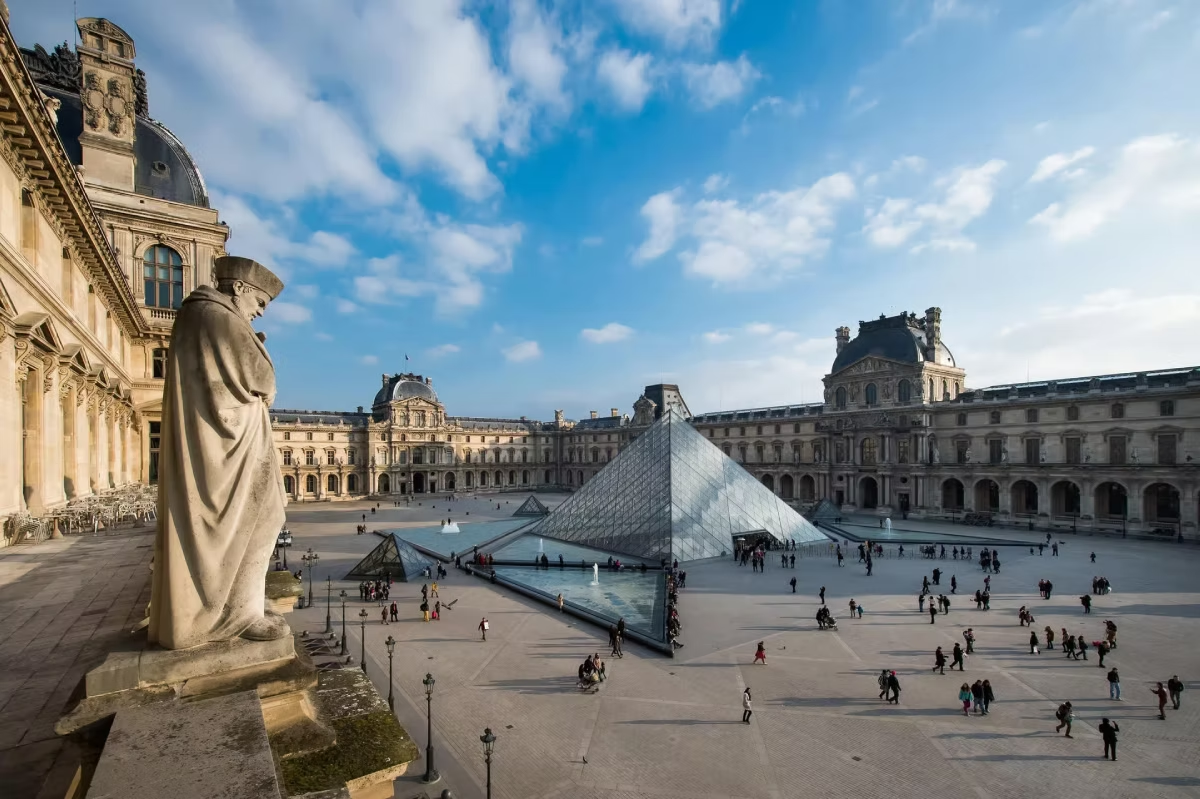
The best neighborhoods to stay near the Louvre are the 1st arrondissement (immediately adjacent), the 2nd arrondissement (3–10 minutes’ walk, better value), the Marais in the 4th (vibrant, 15 minutes’ walk), and Saint-Germain-des-Prés in the 6th (across the Seine, 10–20 minutes’ walk). The 1st offers the shortest commute but highest prices; the 2nd gives you quieter streets and better-value rooms with a 5-minute walk.
Staying near the Louvre means you can start your visit at 9:00 AM without a stressful metro journey — and more importantly, return to your hotel mid-afternoon for a rest without losing half a day. The 1st arrondissement is the obvious answer, but it’s not always the best answer. Several adjacent neighborhoods give you equal convenience with more character and better prices.
This guide covers every sensible area to stay near the Louvre, with honest assessments of who each suits — and includes practical tips on walking distances, metro access, and what to expect from a “near the Louvre” listing.
How Close Is “Near the Louvre”?
Before booking, understand what “near the Louvre” really means. Paris is compact — many neighborhoods are genuinely within walking distance of the museum, but some listings stretch the definition.
Honest walking times from the Louvre Pyramid:
| Area | Walking time | Character |
|---|---|---|
| 1st arrondissement (Palais Royal / Rivoli) | 0–5 min | Immediate, most expensive |
| 2nd arrondissement (Opéra / Sentier) | 5–15 min | Central, good value |
| Marais (3rd & 4th arrondissements) | 15–20 min | Vibrant, historic, moderate prices |
| Saint-Germain-des-Prés (6th) | 10–15 min across Pont du Carrousel | Chic Left Bank, higher prices |
| Montorgueil (2nd) | 10 min | Foodie area, good value |
| Opéra (9th) | 12–18 min | Commercial, mid-range hotels |
Anything more than 20 minutes’ walk isn’t really “near the Louvre” — you’ll be using the metro anyway, and all of Paris is accessible by metro.
The 1st Arrondissement (Immediate, Premium)
The 1st arrondissement surrounds the Louvre itself. Staying here means you walk out your hotel door and are at the Pyramid in under 10 minutes. Most hotels in this area are 4-star or 5-star.
Pros:
- Shortest possible commute to the Louvre, Tuileries, and Place Vendôme
- Walkable to Notre-Dame, Musée d’Orsay, Opéra Garnier
- Quiet at night (few bars/restaurants stay open late)
- Excellent security and infrastructure
- Famous luxury hotels (Ritz, Le Meurice, Mandarin Oriental, Costes)
Cons:
- Expensive — typically €300–1,500+ per night for the best-known hotels
- Sleepy evenings (area empties after 9 PM)
- Tourist-dense during the day
- Smaller boutique options are limited
Best for: Luxury travellers, anniversary trips, business visitors with expense accounts, travellers with limited mobility who want the shortest walk.
Notable streets to look for: Rue de Rivoli, Rue Saint-Honoré, Place Vendôme, Rue Saint-Roch, Rue du Mont-Thabor.
The 2nd Arrondissement (Best Value + Walking Distance)
Directly north of the Louvre, the 2nd arrondissement is our recommended sweet spot for most visitors. You’re still a 5–10 minute walk from the museum, but hotel prices drop significantly and the neighborhood feels genuinely lived-in.
Pros:
- Excellent value — mid-range 3-star and 4-star hotels from €150–280/night
- Foodie-heavy area, particularly around Rue Montorgueil (pedestrianised, covered passages, restaurants and cafés every few metres)
- 5–10 minute walk to the Louvre
- Good metro access (Lines 3, 4, 7, 8, 9)
- Paris’s historic covered passages (Passage des Panoramas, Galerie Vivienne)
- Evenings have more life than the 1st
Cons:
- Some blocks are busier/noisier with nightlife
- Quality varies hotel to hotel — read recent reviews carefully
Best for: First-time Paris visitors, couples, travellers who want to eat well, mid-range budgets.
Notable streets: Rue Montorgueil, Rue Étienne Marcel, Rue des Petits Champs, Rue du 4 Septembre.
The Marais (3rd & 4th Arrondissements)
A 15–20 minute walk east of the Louvre, the Marais is one of Paris’s oldest and most atmospheric neighborhoods. Narrow medieval streets, boutique shops, lively cafés, and several museums (Musée Picasso, Musée Carnavalet). Staying here requires walking a bit further or taking metro Line 1 (3 stops).
Pros:
- One of Paris’s most characterful neighborhoods
- Fantastic restaurants, cocktail bars, vintage shops
- Boutique hotel density is higher here than almost anywhere else in Paris
- Close to Notre-Dame, Place des Vosges, Centre Pompidou
- LGBTQ+-friendly area with genuine local scene
Cons:
- Not quite “walking distance” to the Louvre (you’ll want the metro)
- Very crowded on weekends (the Marais is a local shopping destination)
- Sunday trading differs from most of Paris — many shops and restaurants are open Sundays, closed Mondays
Best for: Repeat Paris visitors, travellers who want atmosphere over proximity, couples, shoppers.
Notable streets: Rue des Francs-Bourgeois, Rue Vieille du Temple, Rue de Sévigné, Place des Vosges.
Saint-Germain-des-Prés (6th Arrondissement)
A 10–15 minute walk across the Seine via Pont du Carrousel, Saint-Germain is the Left Bank’s most famous neighborhood. Old-school Parisian chic, the historic literary cafés (Café de Flore, Les Deux Magots), and plenty of four-star hotels.
Pros:
- Beautiful walk along the Seine to the Louvre
- Minutes from the Musée d’Orsay
- Excellent shopping (international fashion, French boutiques)
- Refined evening atmosphere
Cons:
- Pricey — fewer budget options than the 2nd arrondissement
- A bridge to cross every time you visit the Louvre
- Very tourist-aware (pricing at cafés reflects this)
Best for: Mid-range to luxury travellers combining the Louvre with the Musée d’Orsay, literary and art history enthusiasts.
Notable streets: Boulevard Saint-Germain, Rue de Buci, Rue Jacob, Rue Bonaparte.
Hotel Recommendations by Budget
We don’t take affiliate commissions on hotels and won’t list individual properties here — hotel recommendations age quickly and the best choice depends on your dates. However, here’s how to think about budgets for each area.
Budget (€100–160/night)
- 2nd arrondissement near Sentier or Rue Montorgueil — 3-star hotels, often small rooms but clean and well-located
- Opéra (9th) — mid-range chains, 15-minute walk or 2 metro stops
- Montmartre (18th) — cheaper still, but a longer commute
Mid-Range (€160–300/night)
- 2nd arrondissement — independent 4-star boutique hotels
- Marais — characterful boutique options
- Louvre-side 1st — the more modest 3-star options
Luxury (€300–800/night)
- 1st arrondissement — 4-star and 5-star hotels on Rue de Rivoli and Rue Saint-Honoré
- Place Vendôme area — iconic 5-star addresses
- Saint-Germain — Left Bank 4-star and 5-star hotels
Ultra-Luxury (€800+/night)
- Place Vendôme (Ritz, Mandarin Oriental) — legendary 5-star palaces
- Rue de Rivoli (Le Meurice) — 5-star palace with Louvre views from some suites
- Rue du Faubourg Saint-Honoré — embassy and luxury row
What to Look For When Booking
Proximity to a Line 1 metro station. Line 1 connects the Louvre to Champs-Élysées, Arc de Triomphe, and Bastille — the most useful line for sightseeing. Stations: Palais Royal–Musée du Louvre, Tuileries, Louvre–Rivoli, Châtelet.
Check walking distance on Google Maps. Hotels on booking sites often round down walking times. A listed “5 minutes from the Louvre” can easily be 10.
Street noise. The 1st is quiet, but some 2nd-arrondissement streets have late-night activity. Read recent reviews for noise complaints.
Room size. Paris hotels have tiny rooms by international standards. If a listing says “classic room, 12 m²” it means 12 square metres — room for a bed and a suitcase. Splurge for a slightly larger room if you’re staying more than 3 nights.
Air conditioning. In summer, essential. Some older Paris hotels still don’t have it. Confirm before booking.
Practical Tips for Staying Near the Louvre
Book at least 6–8 weeks ahead for peak season (April–October). Louvre-area hotels fill up fast.
Consider your total Paris itinerary. If you’re only seeing the Louvre briefly, don’t limit yourself to Louvre-adjacent hotels. The metro is efficient and any central arrondissement (1st–8th) works.
Store luggage at your hotel. All reputable hotels store luggage before check-in and after check-out for free. This is invaluable if your visit is the day you’re arriving or leaving Paris.
Hotel breakfasts are expensive. €25–45 is typical. Skip it — grab coffee and a croissant at any nearby bakery for €4–6.
If you’re a wheelchair user, call the hotel. Paris’s older buildings often have small lifts or stairs at entrances. See our Louvre Accessibility guide for recommendations on accessible hotels.
Alternatives to Hotels
Apartment rentals. Often better value for stays over 3 nights, and you get a kitchen and laundry. Be aware Paris has strict short-term rental regulations — book only through verified platforms.
Aparthotels. Brands like Adagio, Citadines, and Fraser Suites combine hotel services with apartment-style rooms. Common in the 1st and 2nd arrondissements. Good middle ground for families.
Hostels. Most Paris hostels are in Montmartre (18th), Bastille (11th), or the Marais (4th). A longer commute but ~€40/night for a bed.
Getting From Your Hotel to the Louvre
From almost any of the neighborhoods above, your options are:
- On foot: Often fastest for hotels within 15 minutes
- Metro: €2.15 per ride; Line 1 is the go-to
- Taxi: €10–15 from most central arrondissements; only worth it with luggage or at night
- Hotel shuttle: Some luxury hotels offer chauffeur service; confirm before booking
See How to Get to the Louvre for a full transport breakdown.
FAQs About Hotels Near the Louvre
What’s the best area to stay near the Louvre?
The 1st arrondissement offers the shortest walk but highest prices. The 2nd arrondissement gives you better value and more character with a 5–10 minute walk. For more atmosphere with a 15-minute commute, the Marais (3rd/4th) is excellent. Saint-Germain (6th) gives you Left Bank chic across the Seine.
How far is the Louvre from central Paris?
The Louvre is central Paris. It’s in the 1st arrondissement, directly on the Seine, and is a 10-minute walk from Notre-Dame, Châtelet, the Opéra, and the Marais.
What’s the cheapest area to stay near the Louvre?
The 2nd arrondissement near Sentier and Rue Montorgueil offers the best value with mid-range 3-star hotels from €100–160/night. The 9th arrondissement (Opéra area) is slightly cheaper but further. Anything in the 1st arrondissement will be pricey.
Should I stay on the Left Bank or Right Bank for the Louvre?
The Louvre is on the Right Bank. Right Bank neighborhoods (1st, 2nd, 3rd, 4th) offer shorter walking routes. Left Bank neighborhoods (6th, 7th) require crossing the Seine but combine better with Musée d’Orsay, Saint-Germain, and the Eiffel Tower.
Are there luxury hotels near the Louvre?
Yes. The 1st arrondissement is home to several of Paris’s most famous 5-star “palace” hotels, including the Ritz Paris, Mandarin Oriental, Le Meurice, and Hôtel de Crillon. Room rates start around €800–1,500 per night and rise substantially for suites.
Is the 1st arrondissement safe at night?
Yes, very. The 1st is one of Paris’s safest arrondissements — well-lit, highly policed, with luxury shopping and hotels that maintain strong security. It can feel quiet after 10 PM because there’s less nightlife, but that’s a pro, not a con, for most visitors.
Can I walk to the Louvre from the Marais?
Yes. The Marais is a 15–20 minute walk from the Louvre along Rue de Rivoli. It’s a pleasant walk past Châtelet and the Hôtel de Ville. Metro Line 1 also connects the two in 5 minutes.
Are there hotels with Louvre views?
A few luxury hotels on Rue de Rivoli have suites with Louvre views, notably Le Meurice. Most 1st-arrondissement hotels have rooftop bars with Louvre views even if individual rooms don’t. Café Marly inside the museum has direct Pyramid views — see Where to Eat at the Louvre for details.
