

Louvre Map & How to Navigate the Wings
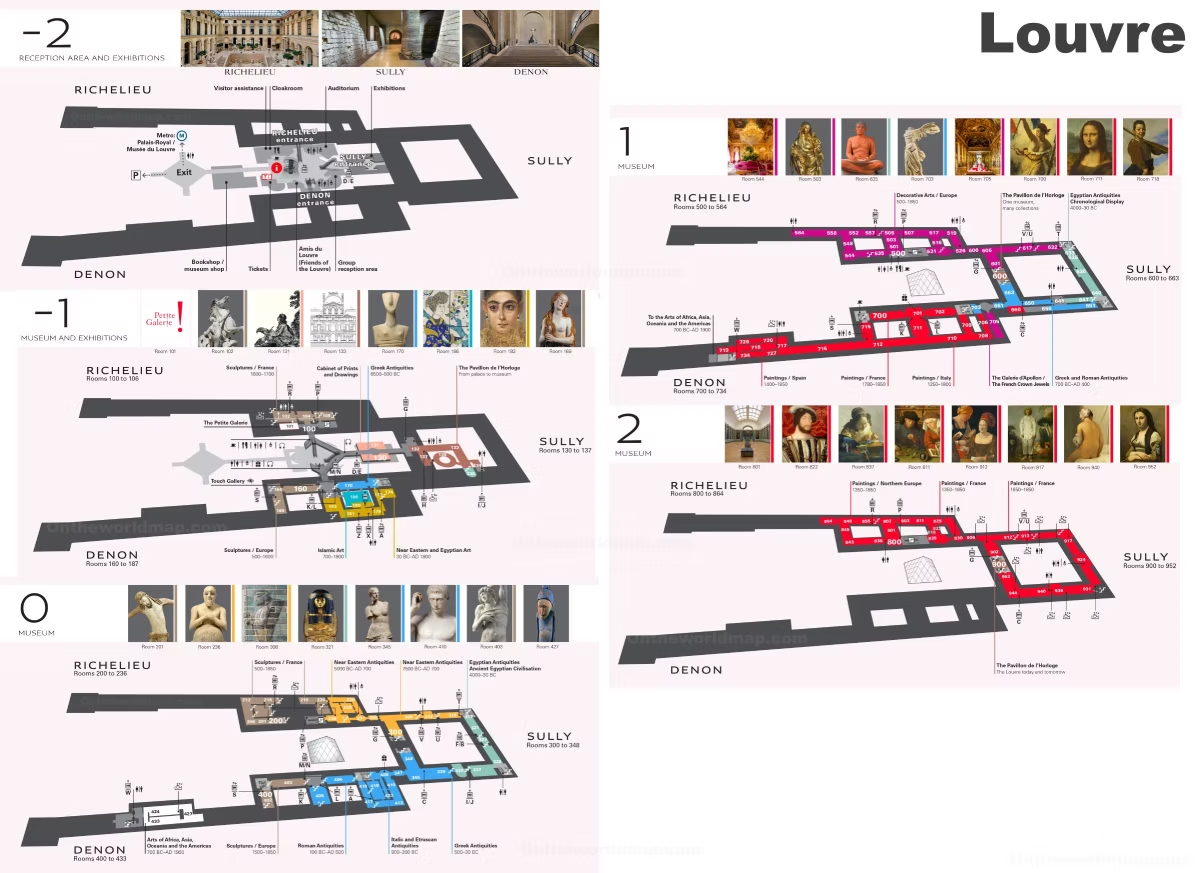
The Louvre is organised into three wings radiating from the central Pyramid entrance: Denon (south, housing the Mona Lisa and most famous paintings), Sully (east, with Venus de Milo and Egyptian antiquities), and Richelieu (north, with French sculpture and decorative arts). Each wing has four floors numbered –1 to +2. The smartest route for first-time visitors is Denon first (when it’s quietest), then Sully, then Richelieu.
The Louvre’s floor plan is famously confusing. It’s a former royal palace expanded, rebuilt, and stitched together over 800 years — not a purpose-built museum. But once you understand the basic structure, you can navigate it confidently. Everything radiates out from one central point: the Hall Napoléon beneath the Pyramid.
This guide breaks down how the Louvre is organised, where each masterpiece lives, how the floor-numbering works, and the smartest walking route to see the highlights without getting lost.
The Louvre’s Three Wings
The Louvre is built around a central courtyard, the Cour Napoléon (where the Pyramid sits). Three wings extend outward from this courtyard, and you always start your visit at the Hall Napoléon directly below the Pyramid.
Denon Wing (south, toward the Seine)
- What’s here: Italian paintings (including the Mona Lisa), French Romantic paintings, Spanish paintings, Greek and Roman sculpture, Michelangelo’s sculptures, Egyptian antiquities (part)
- Famous works: Mona Lisa, Winged Victory of Samothrace, Liberty Leading the People, The Raft of the Medusa, Michelangelo’s Dying Slave
- Crowd level: Highest. Plan to visit this wing first thing in the morning or late Wed/Fri evening.
Sully Wing (east, around the Cour Carrée)
- What’s here: Egyptian antiquities (main collection), Greek antiquities (including Venus de Milo), French paintings (17th–19th centuries), the original medieval Louvre foundations
- Famous works: Venus de Milo, the Seated Scribe, the Great Sphinx of Tanis
- Crowd level: Moderate. Quieter than Denon.
Richelieu Wing (north, facing Rue de Rivoli)
- What’s here: French sculpture (Cour Marly and Cour Puget), decorative arts, Napoleon III apartments, Northern European paintings (Dutch, Flemish, German), Near Eastern antiquities
- Famous works: The Code of Hammurabi, Vermeer’s The Lacemaker, the Napoleon III apartments
- Crowd level: Quietest. Excellent for afternoon visits.
Floor Numbering (–1 to +2)
Every wing has four floors, numbered using a system that makes sense once you know it:
- Floor –1 (Entresol / Lower Ground): Below the Hall Napoléon. Egyptian antiquities, Islamic art, medieval Louvre, Greek pre-classical
- Floor 0 (Ground Floor): Ancient civilisations — Greek, Roman, Egyptian galleries; French sculpture courtyards
- Floor +1 (First Floor): Paintings galleries (including Denon’s Italian paintings and the Mona Lisa), Egyptian antiquities (part), decorative arts, Crown Jewels
- Floor +2 (Second Floor): More paintings (French, Dutch, Flemish, German schools)
The Mona Lisa is on Floor +1 of the Denon Wing. Venus de Milo is on Floor 0 of the Sully Wing. This is worth memorising.
Where Is the Mona Lisa?
The Mona Lisa hangs in the Salle des États (Room 711), on the first floor (+1) of the Denon Wing. From the Hall Napoléon:
- Take the Denon Wing escalator/stairs up to Floor +1
- Walk through the Grande Galerie (the long corridor of Italian paintings)
- Turn into the Salle des États — a large room on the right with a dedicated Mona Lisa barrier
The walking distance is about 400 metres from the Pyramid entrance. Signs pointing to “La Joconde” (the French name for the Mona Lisa) are everywhere, so you won’t miss the turn. For the full story, see The Mona Lisa: Everything You Need to Know.
Where Is Venus de Milo?
Venus de Milo stands in Room 346 on Floor 0 of the Sully Wing, in the Greek antiquities galleries. From the Hall Napoléon:
- Head into the Sully Wing (opposite direction from the Mona Lisa)
- On the ground floor, you’ll enter the Greek galleries
- Venus de Milo is displayed at the end of a long sightline — you’ll see her from the corridor
She’s often less crowded than the Mona Lisa, so you can actually stop and look. For her backstory, see Venus de Milo: History & Where to Find Her.
Where Is the Winged Victory of Samothrace?
The Winged Victory (Nike of Samothrace) is one of the most beautifully displayed works in any museum. She sits at the top of the Daru staircase, which you encounter as you move from the Hall Napoléon toward the first floor of the Denon Wing. You climb up to her — she towers over the landing.
Most 2-hour itineraries put her first. See her before the Mona Lisa — the Daru staircase gets busy around 10:30 AM as tour groups arrive.
The Smartest Route Through the Louvre (for First-Timers)
For a 3–4 hour first visit, follow this route. It minimises backtracking and hits the crowds at the right times.
0:00 — Enter via the Carrousel entrance → arrive at the Hall Napoléon under the Pyramid.
0:10 — Denon Wing first (before crowds peak)
- Climb the Daru staircase to see the Winged Victory of Samothrace
- Continue to Floor +1: Italian paintings in the Grande Galerie
- Mona Lisa in the Salle des États (before 10:30 AM for shortest queue)
- Veronese’s Wedding Feast at Cana (immediately opposite the Mona Lisa — everyone misses this)
- Delacroix’s Liberty Leading the People and Géricault’s Raft of the Medusa in the adjacent French Romantic gallery
1:15 — Transition to Sully Wing
- Walk east along the Grande Galerie, then down to Floor 0
- Venus de Milo in the Greek gallery
- Seated Scribe and other Egyptian highlights
2:15 — Transition to Richelieu Wing
- Cross back through the Hall Napoléon or take the connecting galleries on Floor 0
- Cour Marly and Cour Puget — French sculpture courtyards (covered by glass ceilings, genuinely beautiful)
- Napoleon III Apartments on Floor +1 — lavish imperial decor, often uncrowded
3:30 — Optional additions
- Code of Hammurabi (Richelieu, Near Eastern antiquities)
- Dutch and Flemish paintings on Floor +2 of Richelieu
- Crown Jewels in the Apollo Gallery (when reopened)
4:00 — Exit via the Pyramid for the iconic architectural view before you leave.
The Louvre Floor Plan: Key Orientation Points
Four landmarks help you always know where you are:
The Pyramid & Hall Napoléon. The central hub. Every wing radiates from here. If you’re lost, head back here — it’s well-signed from everywhere.
The Daru Staircase. A dramatic, curving staircase in the Denon Wing. The Winged Victory stands at the top. Once you’ve seen her, you know exactly where you are in Denon.
The Salle des États. The big room with the Mona Lisa. Easy to spot by the crowds.
Cour Marly and Cour Puget. Two enormous glass-ceilinged sculpture courtyards in the Richelieu Wing, filled with monumental French sculpture. Impossible to miss.
Where to Get a Louvre Map
Free paper map: Pick one up at the information desks in the Hall Napoléon as soon as you enter. Available in 9 languages: French, English, Spanish, Italian, German, Portuguese, Chinese, Japanese, Korean.
Digital map: Download the official Louvre app from the app store for iOS or Android. It includes a live floor plan with your location, a room-by-room guide to major works, and suggested thematic tours.
Pre-visit map download: You can download the PDF Louvre map from the official Louvre website before your trip. The Louvre Museum Official Website guide explains where to find it.
Rooms That Are Currently Closed
The Louvre often has rooms temporarily closed due to maintenance, renovation, or special circumstances. Ongoing closures as of 2026:
- Apollo Gallery: Closed since the October 2025 incident. Reopening date not yet confirmed.
- Parts of the Sully Wing: Temporary closures reported due to structural assessments flagged in late 2025.
Before your visit, check the daily closure schedule on the official Louvre website or call +33 (0)1 40 20 53 17.
Losing Your Way: What to Do
Even with a map, you’ll get turned around at the Louvre. A few tips:
- Room numbers are displayed on door frames — use them with your map
- Each wing has its own colour on the maps: Denon is red, Sully is yellow/gold, Richelieu is blue. This colour-coding also appears on signage.
- If you’re completely lost, look for the “Accueil” signs — they point back to the Hall Napoléon
- A small-group guided tour solves navigation entirely — your guide knows every shortcut and closed passage
Frequently Asked Questions
How is the Louvre Museum organised?
The Louvre is organised into three wings — Denon (south), Sully (east), and Richelieu (north) — radiating from the central Hall Napoléon below the Pyramid. Each wing has four floors numbered –1, 0, +1, and +2. Collections are grouped thematically, colour-coded on museum maps.
Which wing of the Louvre has the Mona Lisa?
The Mona Lisa is in the Denon Wing, on the first floor (+1), in the Salle des États (Room 711). Follow the signs for “La Joconde” from the Hall Napoléon — the route is about a 5-minute walk.
Where is Venus de Milo in the Louvre?
Venus de Milo is in the Sully Wing, on the ground floor (0), in Room 346 of the Greek antiquities galleries. She’s displayed at the end of a long corridor, so you’ll spot her from a distance.
How do I get a Louvre map?
You can pick up a free paper map at the information desks in the Hall Napoléon when you enter — available in 9 languages. You can also download the official Louvre app for a digital floor plan with your location and a guided tour function.
What’s the best wing to start with at the Louvre?
Start with the Denon Wing for the highlights (Mona Lisa, Winged Victory of Samothrace, Italian paintings). Visit it first thing in the morning before crowds build. Then move to Sully for ancient antiquities, and finish with the quieter Richelieu.
Is the Louvre hard to navigate?
Yes, the Louvre’s layout is complex — it’s a former palace, not a purpose-built museum. First-time visitors typically lose 20–30 minutes to navigation over a 3-hour visit. A paper or digital map helps; a guided tour removes the problem entirely.
How many rooms does the Louvre have?
The Louvre has over 400 rooms spread across the three wings and four floors, with 35,000 works on display at any one time out of a total collection of nearly 500,000. Even a full-day visit covers only a fraction.
Are there elevators at the Louvre?
Yes, every wing has elevators to all four floors. They’re marked on the map, and Louvre staff can point you to the nearest one. See our Louvre Accessibility guide for complete accessibility information.
